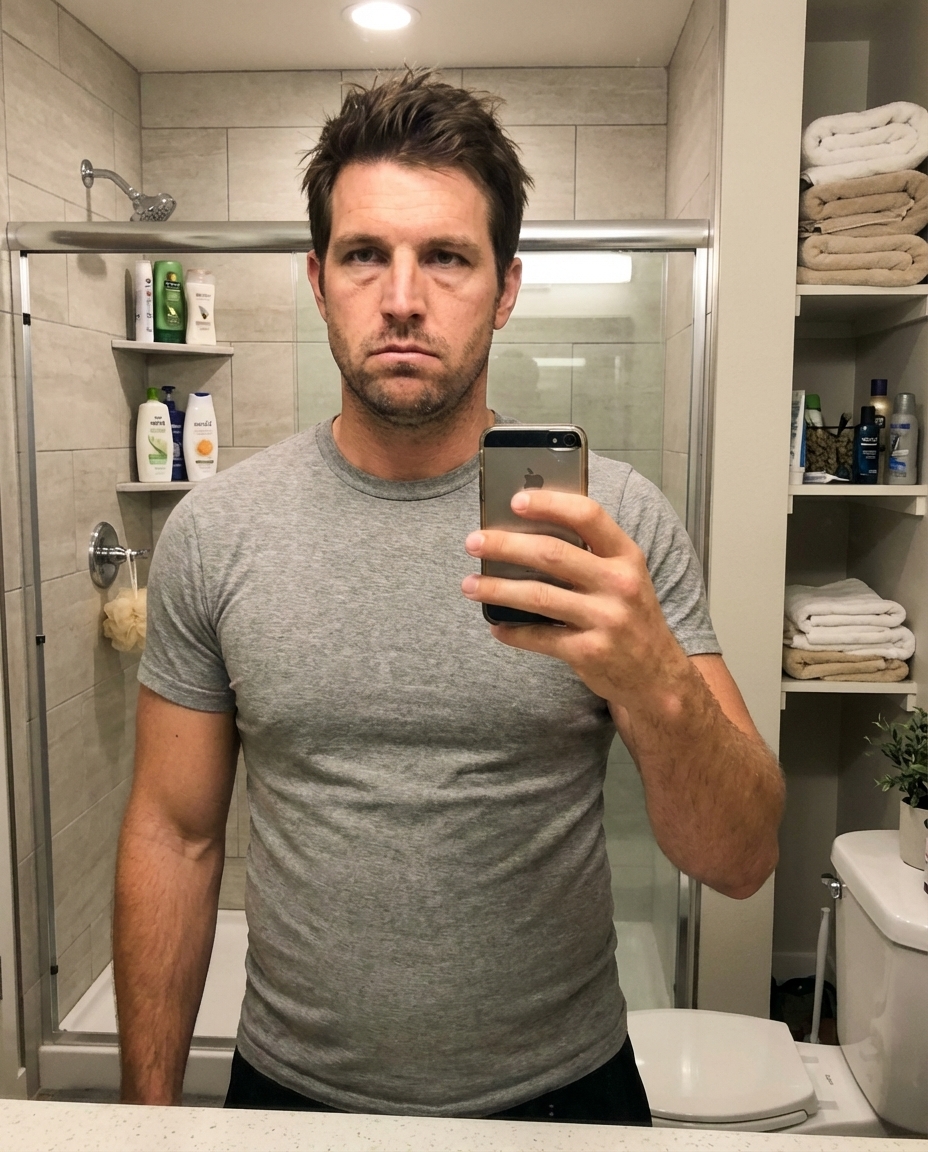
I was 31 years old, standing in my bathroom at 6:14 in the morning, staring at a body I didn't recognize.
When did my face get this puffy? When did my arms get this soft?
I turned sideways. My stomach pushed against my shirt in a way it never used to. I'd been going to the gym four days a week for two straight years. This is what I had to show for it.
I splashed water on my face, grabbed my coffee, and drove to work like nothing was wrong.
That's what I did every morning. Pretended nothing was wrong.
The Slow Fade Nobody Warns You About
It didn't happen overnight. That's the part nobody tells you.
There was no moment where I woke up and thought, "Something is broken." It was more like a dimming. Like someone was slowly turning down the brightness on my life, one percent at a time.
At 27, I was fine. Not incredible — just normal. I could keep up at the gym. I had energy after work. My girlfriend and I were good. I felt like myself.
By 29, I started needing two coffees to get through the afternoon. I figured it was the new job.
By 30, my lifts at the gym stopped going up. Then they started going down. Same program. Same food. Same sleep. But my body was going backward. I told myself I was overtraining.
By 31, it wasn't just the gym.
I was falling asleep on the couch at 8:30 on a Friday night. My girlfriend was in the other room. She stopped trying to wake me up.
I'd look at myself in photos and wonder when I got so… soft. Not fat, exactly. Just undefined. Like someone had taken an eraser to every sharp line on my body.
My brain felt like it was running on dial-up. I'd forget what I walked into a room for. I'd sit at my desk and stare at my screen for twenty minutes without doing anything. My manager pulled me aside and asked if everything was okay at home.
And then there was the thing I couldn't talk about.
My drive — the kind you don't discuss with your friends — was basically gone. I'd lie next to my girlfriend at night and feel nothing. Not anger, not sadness. Just… nothing. Like that part of me had gone quiet.
I was 31 years old. I felt like I was 55.
"You're Fine. It's Probably Just Stress."
I went in for a routine physical. Told my doctor about the fatigue. The brain fog. The gym plateau. I left out the bedroom stuff because I couldn't bring myself to say it out loud.
I asked him to add a full hormone panel to my bloodwork. He agreed, but I could tell he didn't think it was necessary. "You're young. It's probably just stress."
A few days later, the nurse called.
"Everything looks normal."
That was it. No follow-up. No deeper questions. Just: you're normal.
Most guys would have stopped there. Accepted it. Gone home and kept feeling like garbage.
I didn't.
Something didn't add up. So I pulled up the full results myself and started going through the numbers line by line. And on page three, I found what the doctor had glossed over.
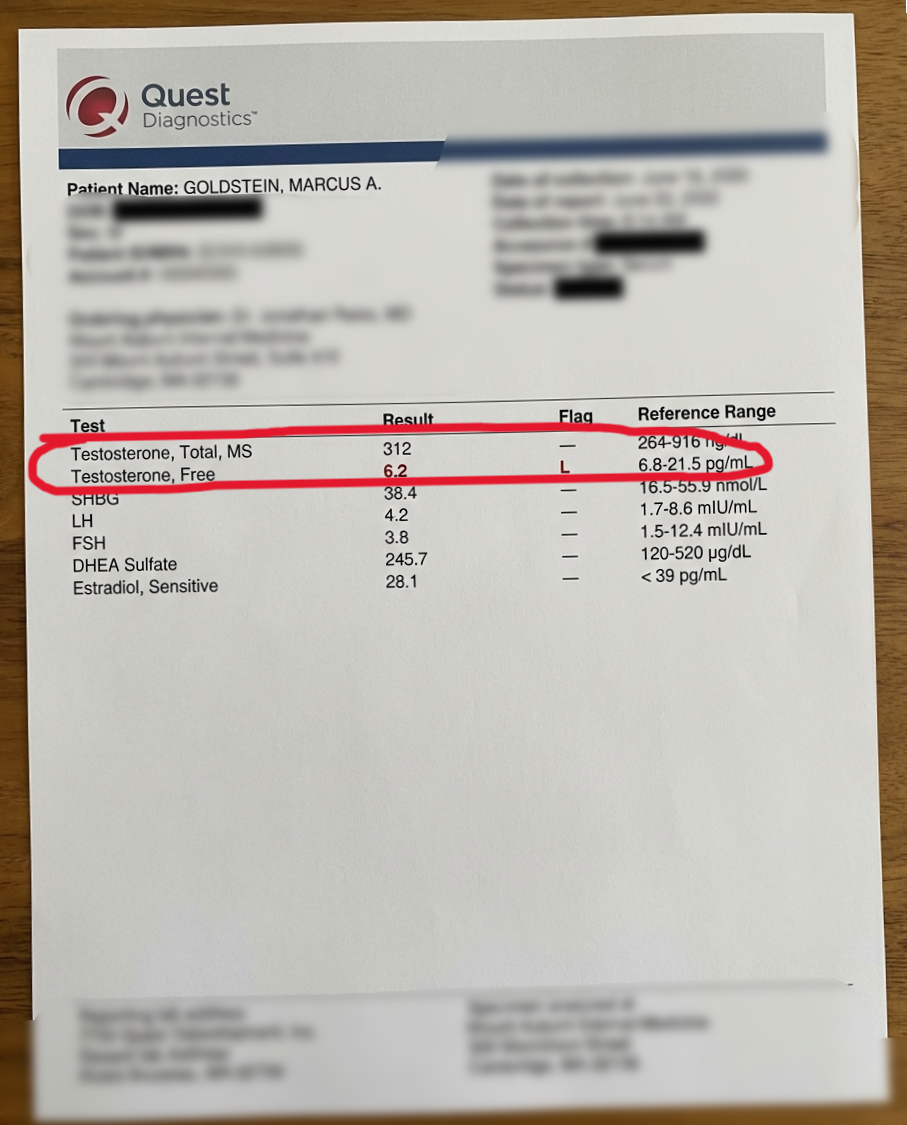
Let me tell you what that number means — because your doctor probably won't.
The American Urological Association says healthy testosterone for adult men ranges between 450 and 600 ng/dL. Recent research on men specifically aged 30 to 34 puts the normal middle range at 359 to 498 ng/dL. Anything below 300 is clinically diagnosed as hypogonadism — meaning your body has stopped producing enough of the hormone that makes you function as a man.
I was at 312. Twelve points above the clinical cutoff.
Just high enough for the system to check the "normal" box. Just low enough to explain every single thing I'd been feeling for two years.
I wasn't lazy. I wasn't broken. I wasn't "just getting older."
My body was running on a fraction of the testosterone it needed. And the standard medical system wasn't built to catch it.
Here's something you should know about me. It's the reason I caught what a trained physician didn't — and it's also the reason it took me so long to fix it.
I have a PhD in Nutritional Sciences. My research focus was on testosterone's downstream effects — what this hormone actually does once it's in your body. How it drives muscle protein synthesis. How it affects neurotransmitter function and mental clarity. How it influences fat distribution, confidence, even how other people perceive you.
I'd spent years in a lab studying what testosterone does. I'd published papers on it. I understood the receptor mechanisms, the cellular pathways, the biology of how this single molecule shapes virtually every quality men care about.
That's why I could read a lab report and see what a general practitioner missed. I knew 312 ng/dL wasn't "normal" for a 31-year-old man — it was a slow-motion crisis.
But here's the humbling truth: understanding what testosterone does is very different from understanding how to fix it when production breaks down. My expertise was downstream — effects, pathways, outcomes. Not upstream — not supplementation science, not clinical interventions, not production optimization.
I was like a mechanic who understands exactly how an engine performs, but has never had to rebuild one from scratch.
That distinction cost me years.
Everything I Tried That Didn't Work (And Why)
Once I understood the problem, I attacked it. But my PhD didn't cover supplementation. So I started where everyone starts — and I documented everything along the way. Every supplement. Every protocol. Every blood draw.
The internet stack. Ashwagandha. Zinc. Vitamin D3. Magnesium. Fenugreek. The full protocol that every Reddit thread and fitness YouTuber swears by. I ran it for 12 weeks. Got my blood drawn again.
Total T: 334 ng/dL. Up 22 points. I couldn't feel any difference. I went back and actually read the supplementation literature — something I'd never had reason to do during my PhD. The studies were weak. Small samples. Marginal effects. Underdosed formulations. The "evidence" I'd been too specialized to examine was barely evidence at all.
The lifestyle overhaul. I optimized my sleep — eight hours minimum, blue-light glasses, cold bedroom, consistent schedule. I overhauled my diet. More healthy fats, more protein, zero processed food, no alcohol for three months straight.
Total T: 351 ng/dL. Another 17 points. Still below the normal range for my age. Still felt like garbage. Foundational — but they can't override a hormonal deficit this deep. I knew that from my own research on testosterone's effects. If the production isn't there, no amount of optimization downstream will compensate.
OTC testosterone boosters. I tried three different brands from Amazon. The ones with thousands of five-star reviews and names that sound like action movies. One had tribulus terrestris. Another had D-aspartic acid. The third was a "proprietary blend" that wouldn't even disclose what was in it.
Total T after 8 weeks: 327 ng/dL. It went down. I'd wasted $180 and two months. When I finally dug into the clinical data on these ingredients — data I'd never had professional reason to review — I understood why. Most of them have zero evidence for raising testosterone in healthy humans. The studies they cite are either in rats, or in men who were already severely deficient due to other health conditions.
At this point, I'd been grinding for almost a year with nothing meaningful to show for it. My relationship was hanging by a thread. My confidence was in the gutter. I was starting to believe that this was just who I was now.
That's when my doctor suggested TRT.
The Solution That Was Supposed to Fix Everything
Testosterone Replacement Therapy. My doctor said it like it was obvious. "Your levels are low. We'll put you on injections. Most guys feel like a new person within weeks."
He prescribed testosterone cypionate. One injection every two weeks. Simple. Clinical. Doctor-approved.
I knew more about what exogenous testosterone does to the body than he did — I'd studied its effects for years. But I'd never studied the clinical protocols. He was a physician recommending standard treatment. And I was desperate.
So I said yes.
My first injection was on a Tuesday morning. By Tuesday afternoon, I felt a rush of something — energy, alertness, a sharpness I hadn't felt in years. For a few hours, I thought: this is it. This is what I've been missing.
That night, I couldn't sleep.
I lay in bed with my eyes wide open until 3am. My heart was pounding. My mind was racing. My body was buzzing with a restless, almost aggressive energy that wouldn't turn off. My testosterone had spiked to an unnaturally high level, and my nervous system didn't know what to do with it.
I finally passed out around 4am. Woke up at 6:30 feeling worse than before.
And that was the best day of TRT.
Here's what nobody tells you about testosterone injections: your levels don't stay stable. They spike violently in the first 24-48 hours, then crash over the next two weeks. There is no consistency. There is no baseline. You're riding a hormonal roller coaster that your body never adapts to.
Day 1: Testosterone spikes. Insomnia. Heart racing. Aggressive, wired energy that isn't usable — it's just anxiety wearing a mask. Painful, cystic acne erupts across my back and shoulders within 48 hours of every single injection. Like clockwork. Deep, scarring acne that made me dread taking my shirt off.
Days 2-5: The spike fades. I'd feel okay for maybe a day or two. Not great. Not transformed. Just… okay. This tiny window was supposedly what I was paying for.
Days 6-14: The crash. My testosterone would plummet as the injection wore off. And here's the cruel part — my body wasn't producing any of its own anymore. So when the injected testosterone faded, I had almost nothing left. I was more exhausted than before I'd started TRT. More irritable. More foggy. I'd snap at my girlfriend over nothing, then sit in my car feeling like I was losing my mind. Zero motivation to train. Zero motivation to do anything.
Then I'd inject again. Another spike. Another sleepless night. Another crash. Every two weeks, the same brutal cycle.
I didn't have a single day where I felt like the person my doctor promised I'd become.
But those weren't even the worst parts.
About four months in, I noticed something in the shower that I'll never forget. My testicles had shrunk. Noticeably. I stood there staring down at my own body, feeling a kind of humiliation I can't describe. I was injecting testosterone to feel more like a man — and the treatment was literally shrinking me.
I understood exactly why. Testicular atrophy. When you inject testosterone from the outside, your brain gets the signal that there's enough testosterone in the blood. So it tells your testes to stop producing their own. They shut down. And when an organ stops working, it shrinks. My body was doing what it was designed to do — and the TRT was the thing causing it.
The injections weren't fixing my body. They were replacing it. And in the process, they were shutting down the very machinery I needed to function as a man.
Then came the part I really couldn't talk about. The very thing that was supposed to make me more of a man was making me feel less like one in the most intimate way possible. Reduced blood flow, reduced natural hormonal signaling to the tissues that depend on it. I was trapped.
If I stopped the injections, my natural production was now even lower than when I started — my body had essentially forgotten how to make its own testosterone. But staying on TRT meant living with acne, insomnia, mood swings, shrinkage, and a roller coaster that never leveled out.
After 11 months, I made the decision to stop.
The crash was brutal.
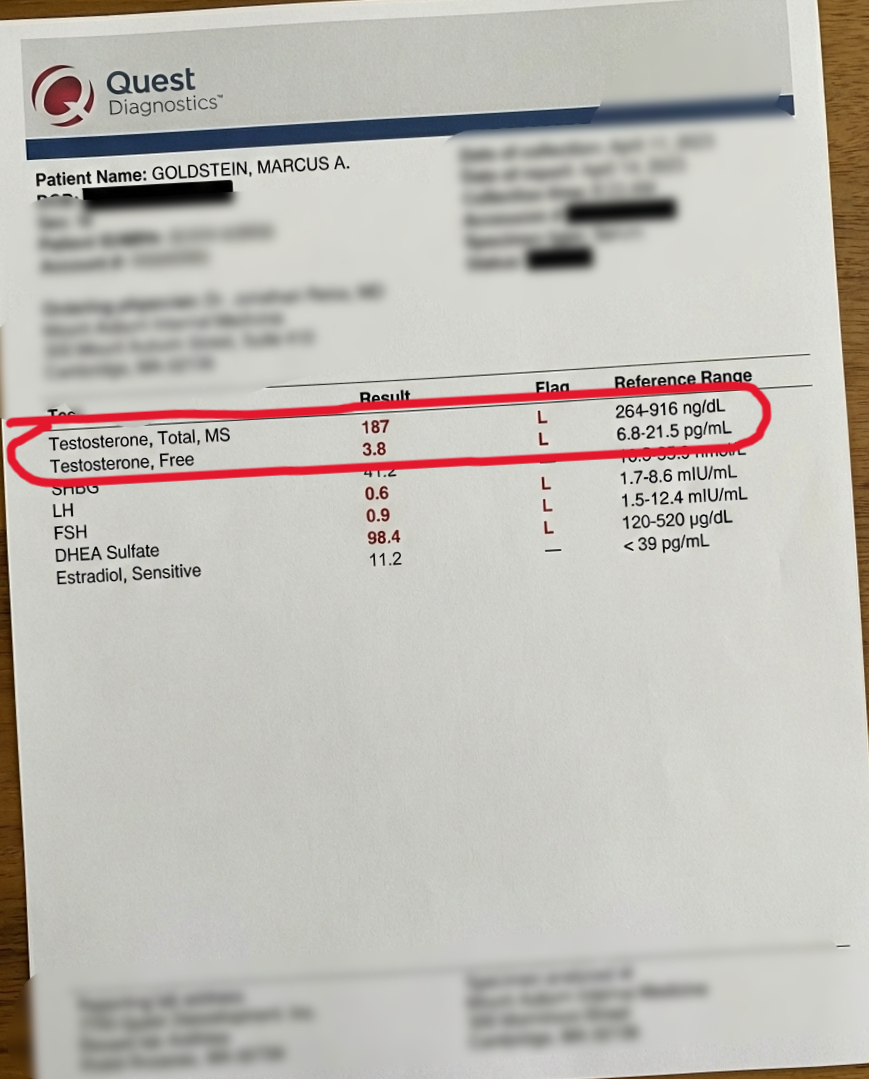
Far lower than the 312 I'd started at.
My body had gone from struggling to produce testosterone to barely producing any at all. The TRT hadn't healed anything. It had created a dependency, masked the real problem, and left me in worse shape than before.
I sat in my car in the clinic parking lot and stared at that number for twenty minutes.
187.
I was 33 years old. And the "standard medical treatment" had made everything worse.
I spent 5 years and a PhD to figure this out. You don't have to.
See What I've Been Taking →The Answer Was in Research I'd Never Done
Here's the thing about hitting bottom: it forces you to look in directions you never would have.
I was a researcher who'd spent his career studying what testosterone does. Now I needed to become a researcher who understood how to make the body produce it.
For the first time, I shifted my entire research lens upstream. Not "what happens when testosterone reaches a muscle cell" — but "what has to happen for testosterone to be produced in the first place?"
This was genuinely new territory for me. And it's what led me to the HPG axis — the production chain I'd been aware of conceptually but had never deeply studied.
To understand why everything I'd tried had failed — and what finally worked — you need to understand how testosterone is actually made. Most people — including most doctors — treat testosterone like it's a simple number. It's low, so you inject more. Problem solved.
But testosterone isn't just a number. It's the end result of a production chain. And if any link in that chain breaks down, your levels drop — no matter what you do.
Here's how it actually works:
The Testosterone Production Chain — HPG Axis
This entire system is called the HPG axis — Hypothalamic-Pituitary-Gonadal axis. It's elegant. It's self-regulating. And in a healthy man, it runs 24/7 without you ever thinking about it.
The problem is that this chain can break down at multiple points. And here's what I realized after going through every failed solution:
TRT destroys this chain. When you inject testosterone from the outside, your brain detects the spike and says: "We have enough. Shut down production." Your pituitary stops releasing LH and FSH. Your testes stop receiving work orders. They shrink. Your natural production crashes to near zero. You're not fixing the chain — you're bypassing it. And once you stop injecting, the chain is in worse shape than before.
OTC supplements don't reach the chain. Zinc, vitamin D, ashwagandha — they might support general health, but they don't meaningfully move the specific hormones and enzymes that drive this production chain. That's why they barely move the needle on bloodwork.
So what does actually work?
I spent months going through production-side literature — a domain I was now learning from scratch, despite my years in adjacent research. I was looking for something that could support the entire chain — from brain signaling to Leydig cell function — without replacing or suppressing any part of it. Something that would help my body produce its own testosterone again, naturally and sustainably.
That search took me far outside the Western endocrinology journals I'd spent my career in. Into domains I'd never explored — ethnopharmacology, traditional medicine compounds that had actually been tested in modern clinical trials.
That's when I found Shilajit.
Why Shilajit Is Different From Everything Else I Tried
I'll be honest — I'd heard the name before and dismissed it. "Ancient Himalayan remedy" isn't the kind of phrase that excites a researcher trained in Western molecular biology. But I wasn't reading headlines anymore. I was reading methods sections and results tables.
A randomized, double-blind, placebo-controlled trial — the gold standard of research — published in Andrologia, tested purified Shilajit on healthy men for 90 days. The results:
- Total testosterone increased by 20%
- Free testosterone increased by 19%
- DHEAS — the main precursor to testosterone — increased significantly
- LH and FSH levels were maintained — not suppressed
That last point stopped me cold.
Every other intervention I'd tried either didn't affect LH and FSH at all (supplements) or actively destroyed them (TRT). Shilajit was the first compound I found that increased testosterone output while keeping the signaling hormones intact. The entire HPG axis was supported — not bypassed.
I dug deeper. Here's what the research showed about the mechanism:
How Shilajit Supports Each Step of the Production Chain
At the brain level: Shilajit helps maintain healthy GnRH signaling by supporting LH and FSH levels. The "work orders" keep flowing to the testes instead of being shut down.
At the precursor level: Shilajit significantly increases DHEAS — the raw material your body converts into testosterone. More precursor = more raw material for the factory.
At the enzyme level: Shilajit activates 3β-HSD and 17β-HSD — the specific enzymes inside Leydig cells that convert DHEAS and other precursors into actual testosterone. It's like upgrading the machinery on the factory floor.
At the cellular level: Shilajit's fulvic acid content acts as an antioxidant, reducing the oxidative stress that damages Leydig cells over time. It also supports mitochondrial function — the energy production inside the cells that actually make testosterone. Healthier cells = better production capacity.
The net effect: Instead of injecting testosterone from the outside and shutting everything down, Shilajit supports every step of the natural production process. Your brain keeps signaling. Your testes keep working. Your enzymes work more efficiently. Your cells are healthier. And the testosterone your body produces is its own — stable, natural, and self-regulating.
No spikes. No crashes. No dependency. No atrophy. The opposite of everything TRT did to me.
I was skeptical. But the research was too solid to ignore. Multiple peer-reviewed studies. Specific, measurable effects on the exact pathways I was targeting. And a safety profile that showed no adverse effects at the studied doses.
So I started taking it. 500mg per day. And I documented everything, like I always do.
What Actually Happened
Week 2. I noticed I wasn't hitting snooze anymore. I'd been a chronic snooze-button guy for three years. One morning I just… woke up. Before my alarm. Lay there like, what is this feeling? It was small. But it was something.
Week 4. My lifts went up. For the first time in over two years, I added weight to my bench press — 10 pounds — and it felt easy. I remember racking the bar and just sitting there, staring at the plates.
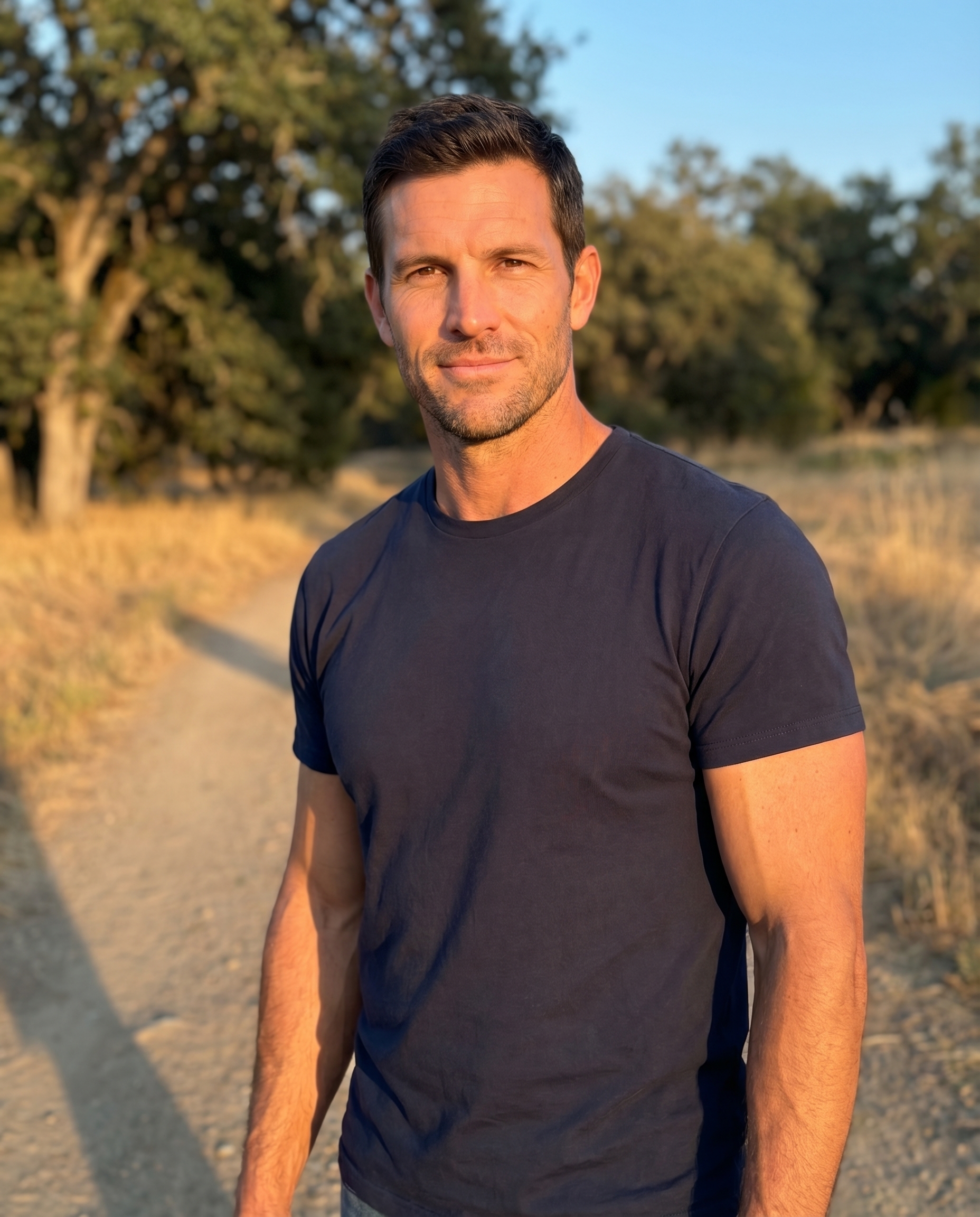
Month 2. I looked in the mirror after a shower and stopped. My face looked leaner. My shoulders looked broader. There was a line forming on my arm that hadn't been there in years. I took a photo. The first one in a long time.
Month 3. I got my bloodwork done.
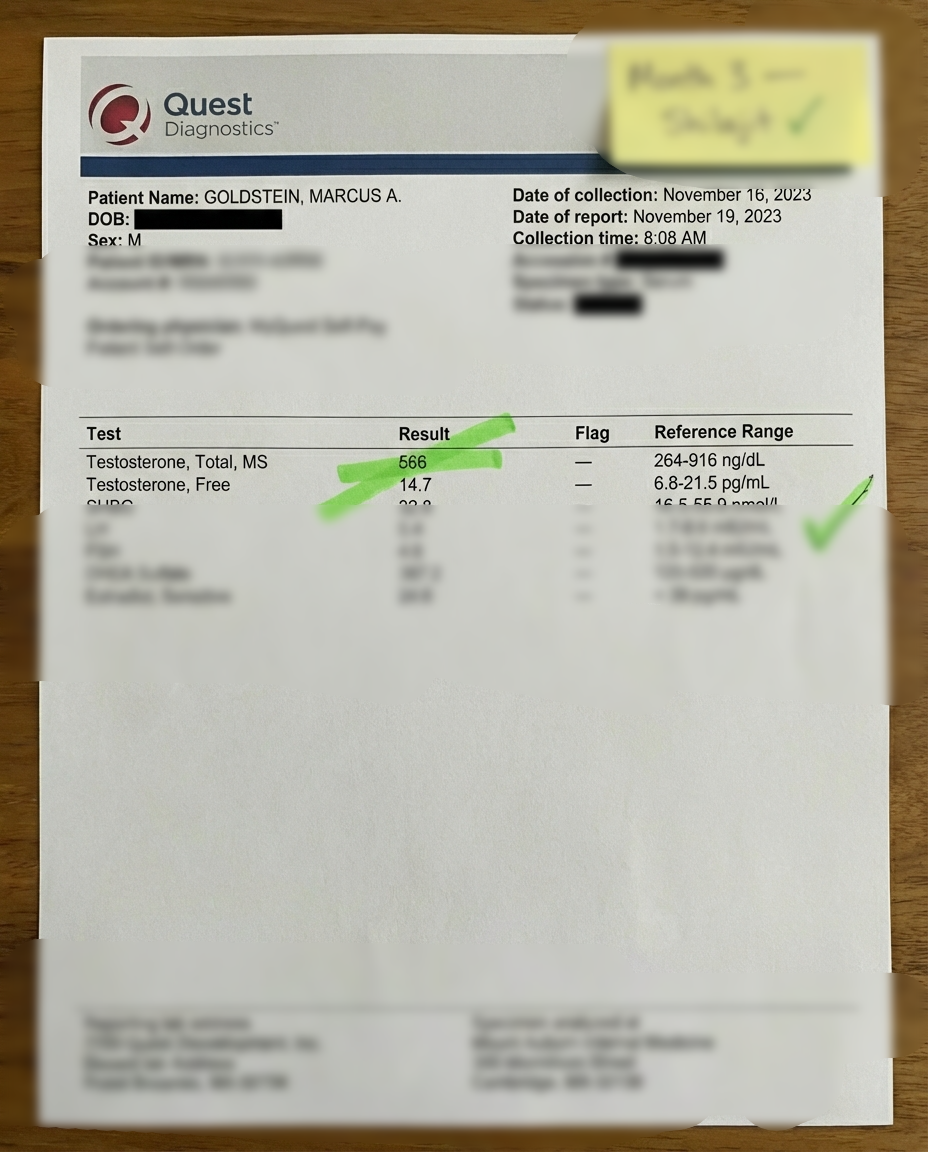
I stared at that number for a long time. 566. Solidly in the healthy range. Up from 187. No injections. No prescriptions. No side effects.
For the first time in five years, my body was producing testosterone the way it was supposed to.
Month 4. My girlfriend grabbed my arm at dinner and said, "Your arms look amazing." She hadn't said anything like that in over a year. That night was the first time in months that I felt like things between us were going to be okay.
Month 5. My buddy at work looked at me across the conference table and said, "Dude, are you on TRT?" I just smiled.
I'd put on 14 pounds of lean muscle and dropped my body fat by about 4%. My energy lasted until 10pm without crashing. My brain felt sharp — the fog was completely gone. I was waking up motivated. Not "I should go to the gym" motivated. Actually wanting to attack the day.
Month 6. I won't go into every detail here. But things changed that I didn't think were possible without pharmaceutical intervention. If you're a man reading this, you know exactly what I'm talking about. My confidence in the bedroom came back in a way I honestly didn't expect. And my girlfriend noticed.
It Wasn't Just Me
I started sharing what I'd found with a few close friends who'd been dealing with the same things. Guys I trusted who'd mentioned the fatigue, the gym plateau, the bedroom stuff when no one else was listening.
"I thought I was just getting old at 29. That didn't even make sense to me, but nothing else explained it. Two months in and my girlfriend said I seem like a different person. My energy is insane. I wish I'd started this sooner."
— James, 29
"I was on TRT for over a year. The injections gave me acne, mood swings, and my doctor kept adjusting the dose because my levels were all over the place. I felt like a lab rat. I wanted off but I was terrified of the crash. I tapered off and started this instead. My last blood test came back at 618 — naturally. No injections. No roller coaster. I actually feel stable for the first time."
— Tyler, 37
"I'd basically accepted that this was my life now. Low energy, no drive, soft body. My wife stopped looking at me the way she used to. I'd tried every supplement on Amazon. Nothing moved the needle. After 4 months on this, my T went from 289 to 534. I feel like I got ten years back."
— David, 42
Here's What I Know Now
I spent five years suffering. Three of them I spent buried in research, looking for an answer my field should have given me. And I still almost lost everything — my relationship, my health, my confidence, my sense of who I was as a man.
Most men don't have a PhD in hormonal regulation. Most men don't have access to research labs. Most men won't spend three years reading endocrinology journals.
That's why I'm writing this.
Because the information is out there. The science is real. The solution exists. But it's buried under layers of garbage supplements, bro-science advice, and a medical system that tells men with 312 ng/dL that they're "fine."
You're not fine. And it's not your fault.
If you're in your late twenties, thirties, or forties and you recognize any of what I've described — the fatigue, the softening body, the brain fog, the disappearing drive, the quiet feeling that something is wrong but you can't name it — please don't do what I did. Don't waste five years pretending it's normal. Don't burn through thousands on supplements that can't work because they're not targeting the actual problem.
And think twice before jumping on TRT. I know your doctor might recommend it. I know it sounds like the easy answer. But injecting testosterone from the outside doesn't fix why your body stopped making it. It replaces your natural production — and once that shuts down, you're dependent for life. I lived through the roller coaster. The acne after every injection. The crash before the next one. The shrinkage. The mood swings. I wouldn't wish that cycle on anyone.
Picture This Instead
Imagine it's six months from now.
You're getting ready in the morning. Nothing special. Just a regular Tuesday.
You glance in the mirror and you stop for a second. Your shoulders are broader. Your stomach is flat. Your jawline is sharper. You look like the version of yourself you'd given up on.
You throw on a t-shirt and it fits the way it's supposed to.
Your phone buzzes. It's her: "You look incredible lately. I don't know what you're doing but don't stop."
You smile. You know.
You walk out the door and you feel it — that quiet, steady confidence you haven't felt in years. Not loud. Not forced. Just... there. Like it was always supposed to be.
That's not a fantasy. That was my life at 35 after spending my entire early thirties in a fog. The difference was one compound, the right mechanism, and enough patience to let my body do what it was designed to do.
I spent 5 years and a PhD to figure this out. You don't have to.
See What I've Been Taking →